
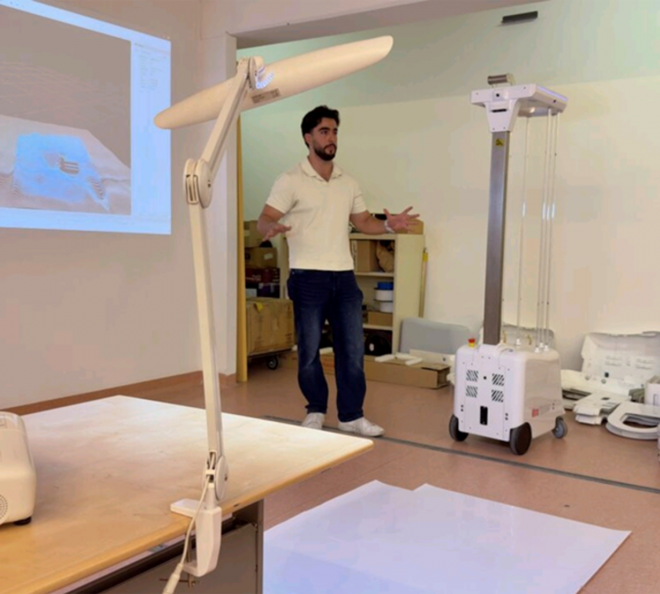
Renatto Tommasi’s trajectory exemplifies the global reach and professional prestige of the IFRoS Master’s programme. His journey highlights the seamless transition from academic excellence to high-impact roles in the space industry. From developing autonomous medical robots to contributing to the Axiom 5 mission and leading project proposals for the European Space Agency (ESA), Renatto demonstrates how our specialized training in AI and field robotics prepares graduates to lead the technological revolution. His story is a testament to the "state-of-the-art" mindset fostered at IFRoS, where students don't just build robots—they shape the future of international exploration and healthcare. Read his full story below.
The Spark: From Legos to Field Robotics
Ever since I was a child back in Mexico, my parents knew I was destined for robotics. My fascination began with Legos and small robots, eventually leading me to graduate with a double degree in Mechatronics in Mexico and Germany. When searching for a Master’s program that could bridge the gap between my passion and the professional world, I found IFRoS (Intelligent Field Robotic Systems). It was exactly what I was looking for: the perfect synergy of academia, hands-on practice, and industry insight.
The IFRoS Experience: A New Perspective
The program was taught by incredible teachers who gave me much more than technical skills; they provided a fresh perspective on both the academic and industrial landscapes. My journey culminated in a Master’s thesis focused on a UVC disinfection robot designed for hospitals. I worked on critical autonomous driving aspects, specifically noise filtering for 3D cameras and improving localization through camera fusion in visual odometry.
Bridging the Gap: From Student to Coordinator
The transition from student to professional was seamless. I am currently working at the same company where I completed my thesis, continuing to develop the robot I spent months researching. One of the most rewarding aspects of my current role is that I now coordinate and mentor two new IFRoS students who are working on their theses with the same robot. This allows me to share my passion and knowledge, ensuring that the work we do doesn't just stay in a thesis, but creates a tangible impact in the real world.
Current Horizons: AI and the Space Industry
Currently, I am working at the European Knowledge Center, where I apply my AI and robotics background to the space industry. My work is currently focused on high-stakes international missions:
- TESH (Telemetry Systems for SpaceHealth): As part of the Hungarian Space Program for the Axiom 5 mission, I developed AI models to filter noise from physiological markers collected by astronaut bodysuits as well as models to estimate the astronauts physiological state and energy levels. This data is critical for understanding how the human body adapts to space.
Medical AI in Space: I am also managing a study with ESA regarding the implementation of Hematology analyzers for the International Space Station.
Projects with the ESA: I am currently leading the preparation of proposals for new exciting project tenders with the European Space Agency (ESA), utilizing my AI knowledge and mechatronics background to assess feasibility for future lunar and orbital technologies.
Final Reflections
Without the specialized training and the "state-of-the-art" mindset I acquired through IFRoS, I would not have the opportunity to contribute to missions like Axiom 5 or collaborate with ESA. IFRoS doesn't just teach you how to build robots; it prepares you to lead in the AI Revolution. I strongly encourage anyone looking to make a global impact in robotics to join this program.